How to play Rainlatch Mini Games
Eight one-thumb games in one place, the same boards for everyone each day, and a best-score board that stays in your browser.
In this guide What Rainlatch Mini Games is The two seed modes The eight games How the board records a run Controls Tips Questions and answers
What Rainlatch Mini Games is
Rainlatch Mini Games is a launcher page for eight small games from the Rainlatch workshop. Each one is built for a phone held upright and one thumb, lasts a minute or two per round, needs no install and no account, and runs entirely in the page. The launcher adds two things the games do not have on their own: a shared seed, so that everyone who plays on the same day gets the same boards, and a board under each card that remembers your best score, your best today and how many rounds you have played.
Tap a card to open a game. It fills the screen with a thin bar at the top that names the game and shows your best. The Games button at the top left, the Escape key or the browser's back button return you to the cards. Scores arrive on the board the moment a round ends.
The two seed modes
| Mode | What it does | When to use it |
|---|---|---|
| Today's seed | Every game starts from a number made of today's date, so the first board, the first route or the first planet is the same for every player that day. | Comparing scores with a friend or with yourself across days. |
| Fresh every time | Each launch rolls a new random seed. No two rounds start the same. | Practice, or when today's board has beaten you enough. |
The switch sits above the cards and the page remembers which one you picked. Bests count in both modes; the board does not separate them, so a record set on a fresh seed stands next to one set on the daily board.
The eight games
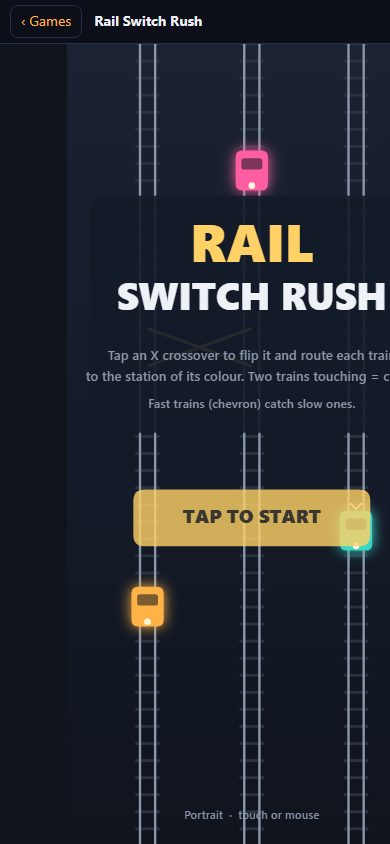
- Rail Switch Rush: trains run in real time on parallel tracks and crossovers link them. Tap a crossover to flip it before two trains meet. Clearing a level starts the next one with more trains.
- Orbit Locksmith: concentric rings carry tumblers. Drag a ring to rotate it and line the tumblers up with the keyway in as few moves as the level allows.
- Color Debt: a grid of coloured tiles that mix like light. Every mix creates a debt in the missing primary colour; pay it by spending a tile of that colour before the ledger fills.
- Shadow Stack: pieces drop from a tray onto a stage and the light casts their shadows on a wall. Match the target silhouette with the pieces you are given.
- Signal Rescue: a storm is coming and a transmitter cannot reach everyone. Place repeaters so the signal, which weakens with every hop, reaches each house in time.
- Echo Path: a route lights up across a grid once. Trace it back from memory. A wrong cell costs a life and the routes grow longer as you go.
- Pulse Grid: one tap sends a pulse across the grid and flips the cells it reaches. Taps are scarce, so read where the chain will travel before you spend one.
- Pocket Terraformer: a tiny planet of twenty-five cells and four kinds of tile. Each placement moves four meters at once; keep all four alive for as long as you can.
How the board records a run
A game reports to the launcher when a round ends, whether you won the level or lost it, together with the score it reached. The launcher compares that number with your best for the game and with your best for the current day and keeps the higher one. A new overall best shows a short message at the bottom of the page. The count of plays goes up by one per finished round, so a level you abandon halfway does not count.
Everything is stored in your browser's local storage under one key. Nothing is sent to a server and there is no account to recover it from, so clearing site data, using a private window or switching browsers starts an empty board. The reset link in the footer clears it on purpose, after a confirmation.
Controls
Every game takes touch and a mouse. Most are tap or drag only; Rail Switch Rush and Echo Path also accept Space or Enter on their result screens to continue, and Color Debt restarts a level with R. The launcher itself works with a keyboard: Tab moves between cards, Enter opens one, Escape closes a game. The games are drawn on a canvas sized for a portrait phone and scale to fit whatever window they get, so a narrow browser window on a desktop works as well as a phone.
Tips
- Play the daily board once in every game before switching to fresh seeds. The daily board is the only one you can compare with anyone else.
- In Rail Switch Rush, watch the slowest train, not the fastest. The fast ones clear the crossings early; the slow one is the one that meets a train coming the other way.
- In Echo Path, say the route out loud as it lights up. The grid gives you nothing once it goes dark, and a spoken sequence survives longer than a watched one.
- In Pulse Grid, count the cells a pulse will reach before you tap. A tap that flips three cells you wanted and two you did not costs more than it earns.
- In Pocket Terraformer, keep the weakest meter in mind rather than the strongest. A planet dies on one empty meter however full the other three are.
- If a score does not appear on the board, finish the round. The games report only when a level is won or lost, not when you leave through the Games button.
Questions and answers
Do my scores sync between my phone and my computer?
No. The board lives in the browser you played in. Each device keeps its own.
Why does my friend's daily board look the same as mine?
That is the point of today's seed. The seed is built from the date, so everyone gets the same starting boards until midnight.
Can I open a single game without the launcher?
Yes. Five of the eight also have their own pages under rainlatch.com/play. Opened there, a game rolls its own seed and reports nothing to a board.
Does the page use sound?
The games are silent. Nothing on the page plays audio.