
In this guide What Twin Pulse is Controls: you set the timing, not the position Reading a barrier Scoring and SYNC Fusion and phase-lock How it ramps Revive and modes Tips Questions and answers
What Twin Pulse is
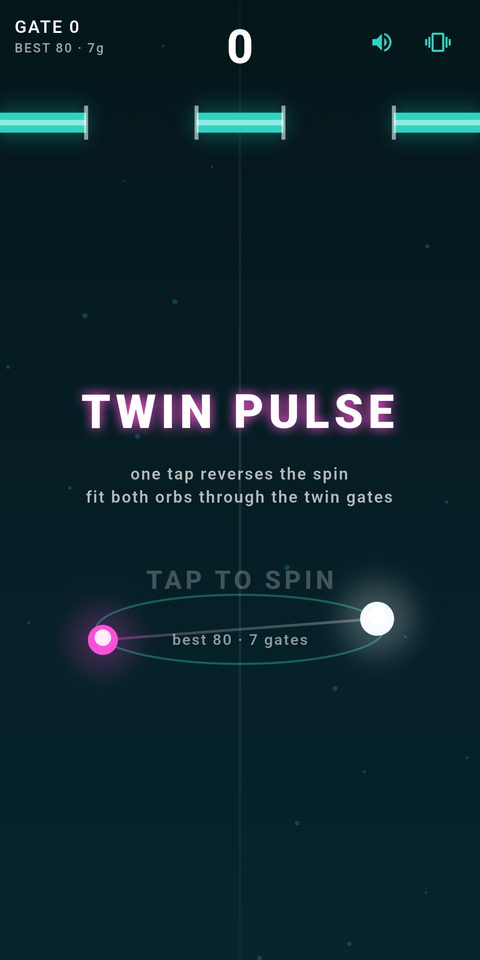
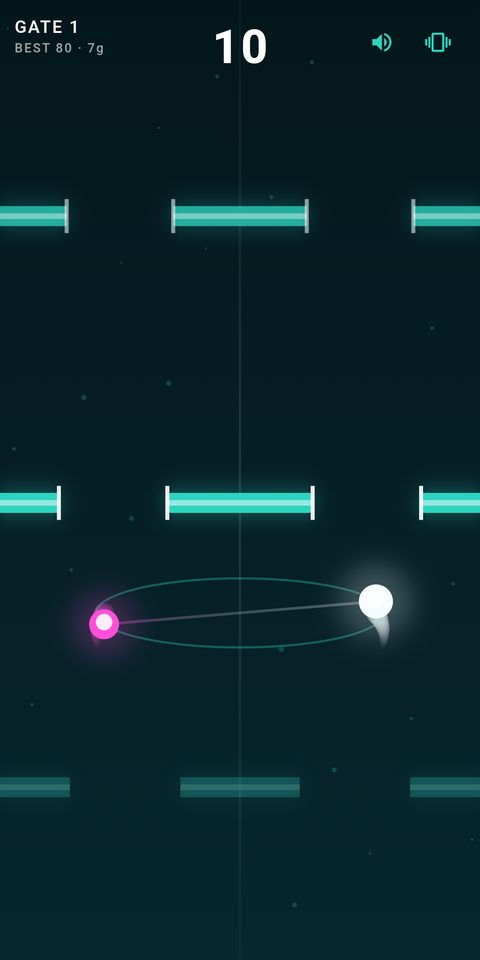
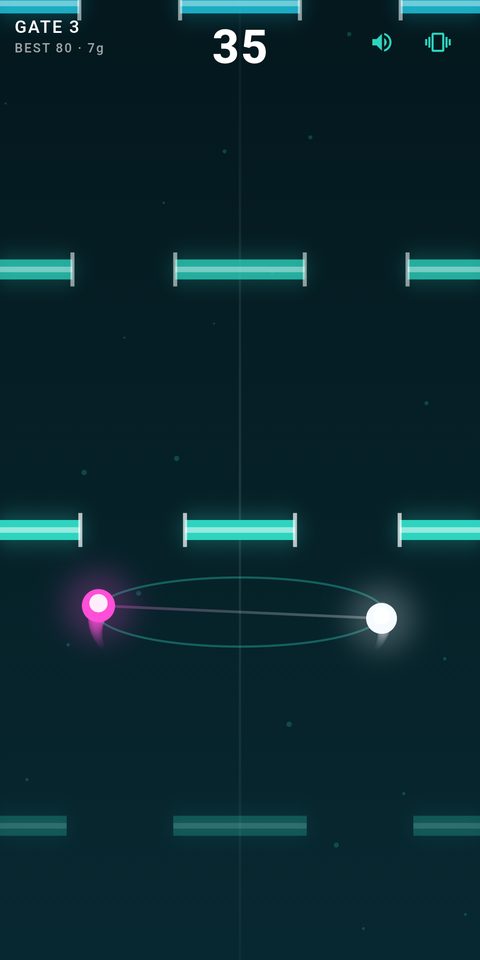
Twin Pulse gives you two glowing orbs that rise together, always mirrored around the center line. Every barrier ahead has two gaps in it, one on each side. At the instant the pair reaches a barrier, each orb has to be inside its gap. Pass as many barriers as you can while the climb slowly speeds up.
Controls: you set the timing, not the position
The orbs sit on an invisible ring that spins, seen edge on. That makes their spread breathe by itself: wide, narrow, together in the middle, then wide again. One tap anywhere reverses the spin, which reverses whether the pair is opening or closing.
You never move the orbs sideways. You only choose when the spread changes direction, so that it has the right width on arrival.
Reading a barrier
Look at where the two gaps sit. Far apart means arrive wide. Close to the middle means arrive narrow. A barrier with a single slot in the center means the orbs must arrive together. Some barriers slide while you approach, so the target is where the gaps will be when you get there. Spacing between barriers always leaves enough time to reach the needed width from any starting position, so no barrier is unfair.
Scoring and SYNC
Each barrier is worth 10 points. Pass with both orbs dead center in their gaps and it counts as a SYNC. Each sync in a row adds 5 points times the length of the streak, counted up to ten, and one sloppy pass resets the streak. The run ends the moment an orb touches a barrier, whether the pair was too wide or too narrow, and the result card tells you which.
Fusion and phase-lock
Chain five syncs in a row and the orbs FUSE into one for four seconds. While fused, slipping through any single gap counts as a pass.
Deeper into the climb you will meet violet PHASE-LOCK barriers. Their two gaps drift independently instead of mirroring each other, so the safe arrival is the middle of where both gaps will be.
How it ramps
| What changes | Early | Late |
|---|---|---|
| Climb speed | Slow | More than twice as fast |
| Spin of the ring | Gentle | About 60 percent faster |
| Width of each gap | Generous | Roughly half as wide |
| Sliding barriers and center slots | None | From the thirteenth barrier |
Revive and modes
A shatter triggers a three-second TAP TO REVIVE once in every run. Take it and the pair carries on with a short shield. The title screen has CLASSIC and HYPER. In Hyper the ring spins 25 percent faster and points are multiplied by 1.5.
Tips
- The spread lingers near its widest and its narrowest points. Reverse the spin there to hold a width for longer.
- Decide on the next barrier early. Last-moment reversals are the main cause of shatters.
- Use the result card. It says whether the pair was too wide or too narrow, which tells you which way to shift the next reversal.
- While fused, only one gap has to be hit, so send the single orb at whichever opening it is already heading toward.
- On a phase-lock barrier, ignore the mirror habit. Watch both gaps separately and settle on the width that fits between them.
- Protect a streak of four. The fifth sync brings fusion, which makes the next few barriers much easier.
Questions and answers
Can I move one orb without the other?
No. The orbs are always mirrored, and a tap affects both by reversing the spin.
How do I trigger fusion?
Make five SYNC passes in a row. The orbs then merge for four seconds.
What is different about a violet barrier?
It is a phase-lock barrier. Its gaps move independently, so they are not always mirrored.
Is a barrier ever impossible?
No. Barriers are spaced so the required width can be reached in time from any position.