In this guide What Gate Morph is Controls: one cycle, one direction Fitting the stencil Scoring and SNAP Ghost, double walls and modes How the difficulty builds Tips Questions and answers
What Gate Morph is
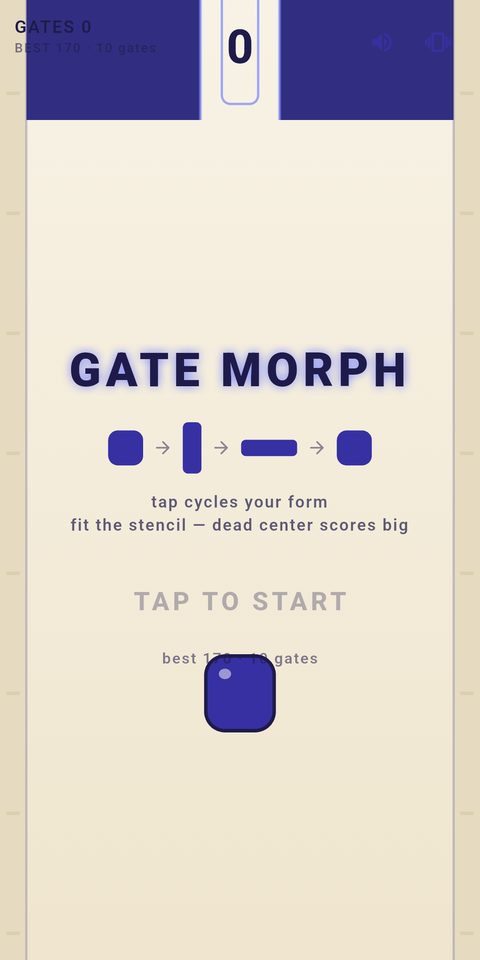
Gate Morph is a one-tap shape runner. Your shape rises on its own toward a series of stencil walls. Each wall has a hole cut in one of three outlines, and you have to be that outline when you get there. Speed climbs with every gate, and a single failed wall ends the run.
Controls: one cycle, one direction
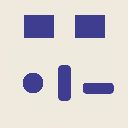
Tap anywhere to morph. Each tap moves one step around a fixed cycle: COMPACT, then TALL, then WIDE, then back to COMPACT. The cycle only runs one way, so going back one shape costs two taps.
A morph takes a fraction of a second. Taps made while one is still running are queued and played in order, so two quick taps always mean two steps and you can plan ahead without waiting for the animation.
Fitting the stencil
At the instant your leading edge reaches a wall, two things must be true. You must be fully settled in the matching shape, not halfway through a morph. And the hole, which slides from side to side on many walls, must be over you at that moment.
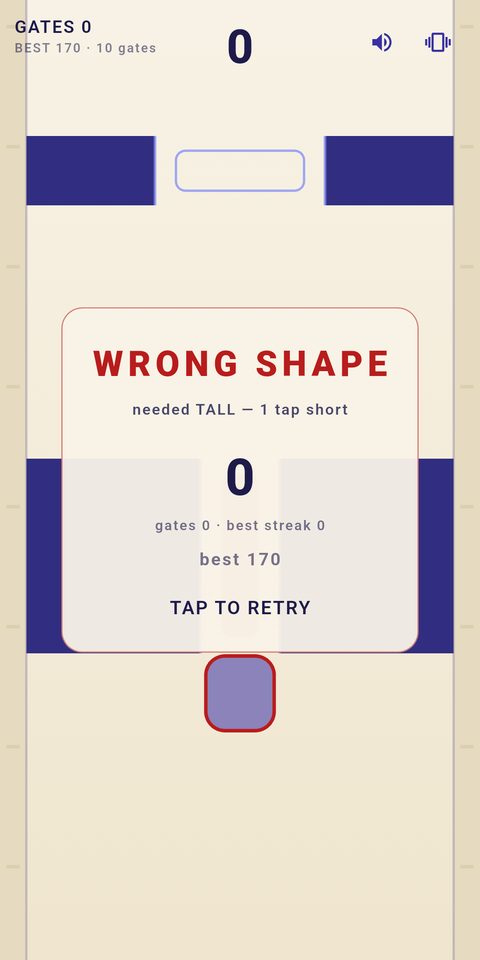
Miss either and the result card names the exact cause: wrong shape, still mid-morph, or the right shape with the hole too far to one side.
Scoring and SNAP
Every gate scores. Settling into the final shape late but cleanly, within about half a second of contact, earns a SNAP. Back-to-back snaps build a streak worth more each gate, up to 50 extra points. Morphing early is always safe but resets the streak. A pass with the hole almost dead center on you adds 5 more. A chime marks every 25 gates.
Ghost, double walls and modes
- GHOST: once you reach 30 points in a run, a fourth, see-through shape joins the cycle. It slips through any wall but scores nothing for that gate. It also makes the cycle four steps long.
- DOUBLE WALLS: later in a run two identical stencils arrive back to back. Hold your shape through both.
- REVIVE: a quick tap after a crash brings you back with a short shield, one time in each run.
- HYPER: picked on the title screen. The run moves at 1.25 times the speed and pays 1.5 times the points.
How the difficulty builds
The opening walls are slow, centered and need a single tap each. After that, walls arrive closer together and faster, the tolerance for a centered hole shrinks, holes start off center, then begin to slide, and finally rapid two-wall sequences appear.
Tips
- Read the hole, not the wall. Its outline is the shape you need, so count your taps as soon as you can see it.
- Count in steps of the cycle. From TALL, WIDE is one tap and COMPACT is two.
- Queue taps early and let them play out. Two fast taps are never lost.
- On a sliding hole the shape is half the job. Arrive when the hole is crossing your column.
- Use the ghost as a planned skip on a wall you cannot reach in time, and remember it adds a tap to every later trip around the cycle.
- For snaps, make the last tap late on purpose but never so late that the morph is still running at the wall.
Questions and answers
Can I morph backwards?
No. The cycle only goes forward, so the previous shape is two taps away, or three once the ghost has been unlocked.
What happens if I tap during a morph?
The tap is queued and plays as soon as the current morph finishes.
Does the ghost shape score?
No. It passes any wall safely but that gate is worth nothing.
Why did I crash in the right shape?
Either the morph had not finished settling, or the hole was too far to the side when you arrived. The result card says which.