
In this guide What Circuit Sprint is Controls What rides on the traces Scoring and the charge streak Extras that appear during a run The fairness rule Tips Questions and answers
What Circuit Sprint is
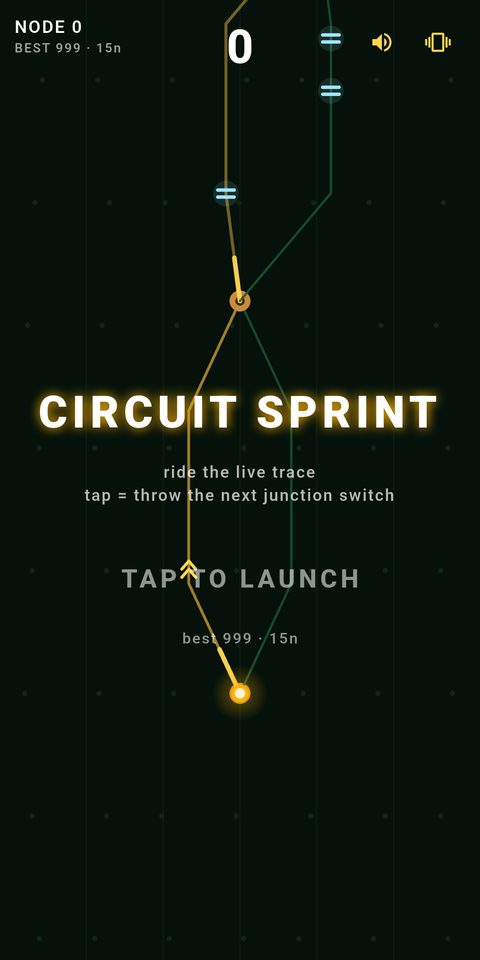
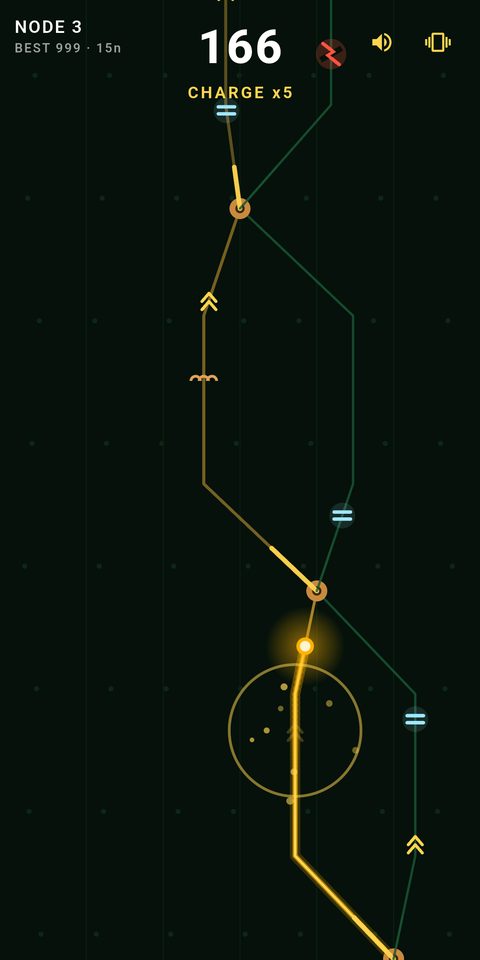
Circuit Sprint is a routing game on an endless printed circuit board. An amber pulse travels up the board by itself. Between every pair of junction pads run two parallel traces, and a switch at the junction decides which one the pulse takes. You never steer the pulse. You only set the switch ahead of it, again and again, as the pulse gets faster with every junction it passes.
Controls
One tap anywhere flips the switch at the NEXT junction, swapping which trace the pulse will ride. The switch locks just before the pulse arrives, and a tap after that does nothing, so decisions have to be made early. Tap once to launch a run and tap after a burnout to try again.
What rides on the traces
| On the trace | Effect |
|---|---|
| Capacitor | 25 points. |
| Coil | 40 points. |
| Boost diode | 15 points and a burst of speed. |
| x2 chip | Doubles your score for a stretch. |
| Express trace | A faster shortcut that pays 20 extra. |
| Blinking spark gap | Opens and shuts on a rhythm. Crossing while open pays 15, or 30 for a last-instant squeeze. Crossing while shut is fatal. |
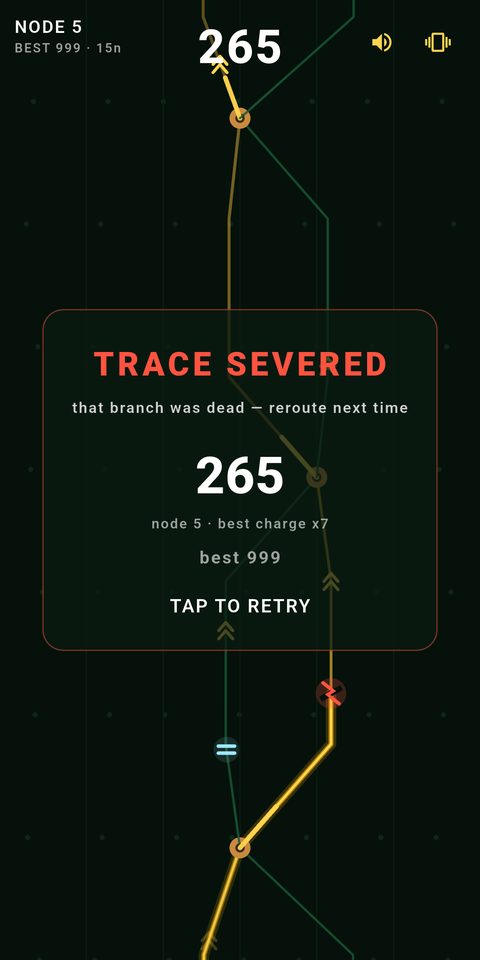
| Solid red spark | A severed trace. It never opens and is always fatal. |
| Nothing (a cold trace) | Safe, but it breaks the charge streak. |
Scoring and the charge streak
Every junction you pass pays 10 points plus 2 for each step of your charge streak, counted up to fifteen steps. Pickups and open spark gaps build the streak, and a cold trace resets it, so a lively route is worth far more than a merely safe one. Traces you have traveled stay lit behind you, and a banner sounds every 25 junctions.
Extras that appear during a run
- OVERCLOCK chips give five seconds of double speed and double points, and the screen glows while one is active.
- BRANCH-3 junctions appear from a score of 40. They have a third trace, and each tap cycles the switch through all three.
- REVIVE is a once-per-run offer after a burnout: tap quickly and the pulse returns with a short shield.
- HYPER mode, chosen before the run, moves the pulse 25 percent faster and multiplies points by 1.5.
The fairness rule
The board is generated so that every junction always has at least one trace with no spark on it. A safe route exists forever. Every burnout is therefore a choice that could have gone the other way, or a tap that came after the switch had locked.
Tips
- Flip early. Once the pulse is close the switch is locked and a late tap is wasted.
- Learn the two sparks at a glance. Solid red is a dead end, and a blinking gap is a timing question.
- When both traces are safe, take the one with pickups. The charge streak raises the value of every junction after it.
- Avoid cold traces unless the other option is a spark. One empty trace throws away the whole streak.
- During an overclock, think one junction further ahead than usual, because everything arrives twice as fast.
- At a three-way junction, count taps. Two taps reach the trace that one tap skipped.
Questions and answers
Do I control the pulse directly?
No. You only flip the switch at the junction ahead of it.
Can both traces be deadly?
No. At least one option at every junction is free of sparks.
Why did my tap not change the switch?
The switch locks shortly before the pulse reaches the junction. Taps after that point are ignored.
What breaks the charge streak?
Riding a cold trace, one with nothing on it.